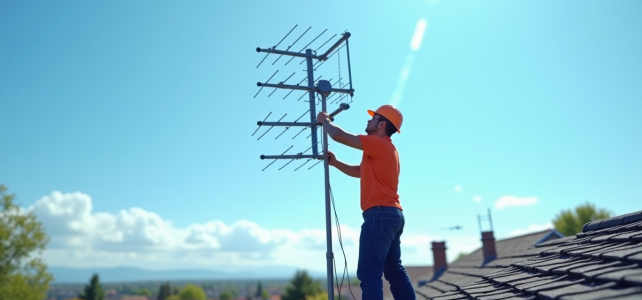
To fully enjoy your favorite TV programs, the correct installation of your TV antenna is essential. Whether you are in an urban or rural area, the quality of reception largely depends on how the antenna is positioned and oriented. You need to follow specific steps to ensure a clear image without interference.
The choice of the right equipment, the ideal location, and the final adjustments are crucial elements. By following these key steps, you will ensure optimal reception and an uninterrupted viewing experience. The success of this installation relies on technical details that are accessible to everyone.
Read also : Organizing Your Trip to Mauritius: Essential Information for a Successful Stay
Choosing and Preparing Your TV Antenna
The first step towards optimal reception begins with the appropriate choice of your antenna. Several options are available to you depending on your needs and location: outdoor antenna, satellite dish, or indoor antenna. For receiving TNT channels, an outdoor antenna mounted on a mast is often recommended. In contrast, for satellite television channels, a satellite dish is necessary.
Preparing the Equipment
Before proceeding with the installation, gather all the necessary equipment. You will need:
Further reading : Tips and Key Steps for Successfully Installing Plasterboard Partitions at Home
- A TV antenna suitable for your needs
- A mounting mast
- A coaxial cable to connect the antenna to your television
- An amplifier to boost the signal if necessary
- A TV distribution box if you need to power multiple antenna sockets
Positioning the Antenna
To ensure optimal reception, the location of your antenna is fundamental. Mount it on a mast, preferably at a height, and make sure it is oriented towards the nearest TV transmitter. Use a compass for precise orientation.
Refer to the wiring diagram for a TV antenna for a clear and error-free installation. Check the compatibility of your antenna with the channels you wish to receive, particularly the TNT channels. An amplifier can be added to strengthen the signal if your area is far from the transmitters.
By following these steps, you not only ensure the quality of reception but also the longevity of your equipment. A well-thought-out and properly executed installation is the key to fully enjoying your favorite TV programs.
Installing and Adjusting Your TV Antenna
Secure your TV antenna on a stable support, such as an exterior wall, a chimney, or in the attic. Ensure that the mounting mast is well anchored to avoid any movement that could affect the signal quality. Once the antenna is securely installed, orient it towards the nearest TV transmitter using a compass. This step is crucial for capturing terrestrial digital television signals.
Connections and Adjustments
Connect the coaxial cable to your antenna and then to the amplifier if you are using one. From there, the cable should be connected to the TV distribution box to distribute the signal to the various antenna sockets in your home. Ensure that all connections are secure to avoid any signal loss. Then plug in your television and, if necessary, add a TNT decoder to receive digital television channels.
Optimizing Reception
To ensure optimal reception of channels, follow these steps:
- Use the information provided by the CSA to accurately locate the available TV transmitters in your area.
- Perform a channel scan on your television to detect and save the available channels.
- If the signal quality is weak, slightly adjust the orientation of the antenna and check again.
Reception of channels can be affected by various factors such as distance from the transmitters and surrounding obstacles. By following these steps, you will be able to optimize the signal quality and fully enjoy your favorite TV programs.