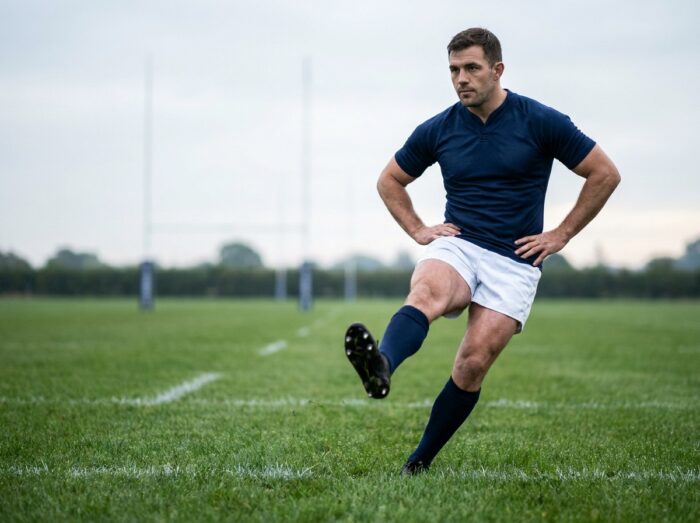
A match that exceeds the usual regulatory duration, whether it involves extra time in the final phase or an expanded competition format, imposes physiological constraints that traditional warm-up does not cover. The goal is not to warm up longer, but to structure the preparation so that the neuromuscular system remains activated over an extended time frame without generating early fatigue.
Thermoregulation and maintaining neuromuscular activation before an extended match
The loss of muscle heat after a complete warm-up is the first factor of underperformance at the start of the match. A study conducted in rugby league on the passive maintenance of heat after warm-up showed that keeping players warm improves their high-intensity activity during the initial phases of play. The issue becomes even more acute when the match format suggests a playing time longer than normal.
Specifically, the window between the end of the warm-up and the kick-off should not become a passive dead time. Covering up with thermal compression clothing and maintaining light movement (active walking, low-intensity joint mobility) preserves intramuscular temperature without depleting glycogen reserves. Repeating a complete warm-up would be counterproductive: the additional energy expenditure would cut into the reserves needed to sustain the extended duration.
The choice of appropriate equipment, including shoes, plays a role in the quality of activation. A player wearing their well-worn Canterbury cleats from training will maintain better proprioception than with a new pair, which matters when foot placements will be challenged over an unusual duration.
Rugby warm-up: structuring phases to anticipate extra time
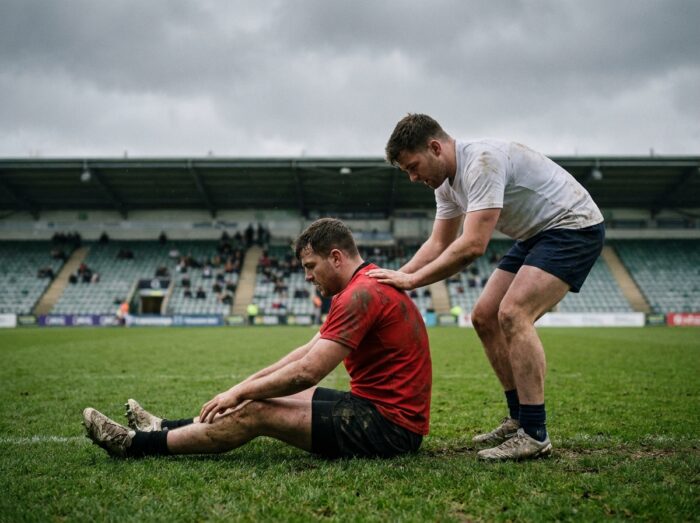
The common mistake is to extend the warm-up proportionally to the duration of the match. A longer match does not require a longer warm-up, but a better-sequenced warm-up. The logic is based on three distinct phases whose proportions change.
Cardiovascular phase: reduce volume, maintain intensity
The rise in core temperature should remain brief. Limiting continuous running to a few minutes is sufficient to reach the desired activation threshold. The goal is to conserve muscle glycogen while elevating the resting heart rate.
Replacing part of the traditional jogging with ball exercises (moving passes, light line-out play) allows for coupling cardiovascular activation and technical cues without adding unnecessary volume.
Muscle potentiation phase: target the groups stressed at the end of the match
This is the phase that changes the most in the context of an extended match. The hamstrings, adductors, and hip rotators are the groups most exposed to injuries at the end of the game when neuromuscular fatigue reduces the quality of eccentric contractions.
Integrating light eccentric exercises into the warm-up (Nordic hamstring with reduced range, controlled lateral lunges) pre-activates these muscle chains. This does not replace a regular prevention program, but it creates a reserve of mechanical tolerance for the late phases of the match.
- Nordic hamstring for 3 to 4 repetitions at partial range, without going to the ground, to target the hamstrings eccentrically without excessive fatigue
- Lateral lunges with a hold of 2 to 3 seconds in the low position, targeting the adductors and hip stability
- Short isometric squats (hold at mid-range) to activate the quadriceps and glutes in angles close to tackling
Specific rugby phase: simulate contact intensity
Progressive contact exercises (tackle shields, low-intensity standing wrestling) should be included in the warm-up, but their volume should decrease as match duration increases. Reducing the number of impacts by about a third compared to a standard warm-up helps limit micro-traumas even before kick-off.
Half-time management and reactivation in case of rugby extra time
Extra time and pre-match delays pose two distinct problems. Before the match, heat is maintained. At half-time of an extended match, accumulated fatigue is managed while reactivating activation.
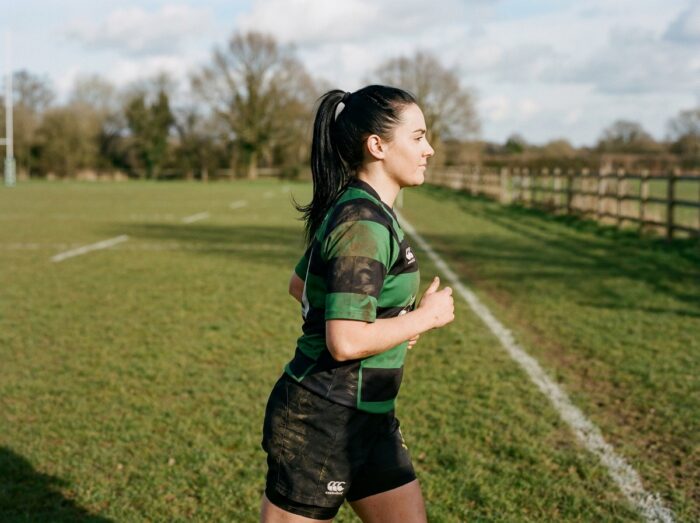
During a standard half-time, most players remain seated. If the match includes extra time, this passivity amplifies muscle stiffness and decreases peripheral temperature. The reactivation strategy must be planned before the match.
- Dynamic mobility of hips and ankles right after the half-time briefing, without waiting to return to the field
- Short sprints (3 to 4 progressive accelerations over 15 to 20 meters) in the last two minutes before resuming
- Light ballistic stretches of calves and hamstrings, avoiding prolonged static stretches that reduce force production capacity
- Wearing thermal layers throughout the break to limit the drop in muscle temperature
Not turning reactivation into an additional session remains the guiding principle. A few minutes of mobility and accelerations are sufficient. The body has already exerted considerable effort, and the priority shifts to energy management.
Joint injury prevention in extended rugby matches
Joint injury prevention programs in rugby rely on repeated practice over the weeks. An isolated warm-up, even if well designed, does not compensate for the lack of regular preventive work. However, it can act as a last line of defense if the right movements are integrated.
The ankles and knees undergo cumulative mechanical stresses that increase non-linearly with match duration. Proprioception significantly deteriorates beyond the usual playing time, exposing ligaments to forces that motor control can no longer compensate for.
Including single-leg balance exercises in the warm-up (standing on one foot, eyes closed, on a soft surface) stimulates the joint mechanoreceptors. This proprioceptive stimulus takes only a few seconds per exercise and represents a minimal investment for a measurable benefit at the end of the match.
Adapting the warm-up to a match longer than usual is not just about adding time or exercises. The logic is the opposite: conserve energy during preparation to release it when the match exceeds its normal duration. Sequencing the phases, reducing contact volume, pre-activating eccentric chains, and planning reactivation at half-time form a coherent protocol that protects performance and limits the risk of injury.