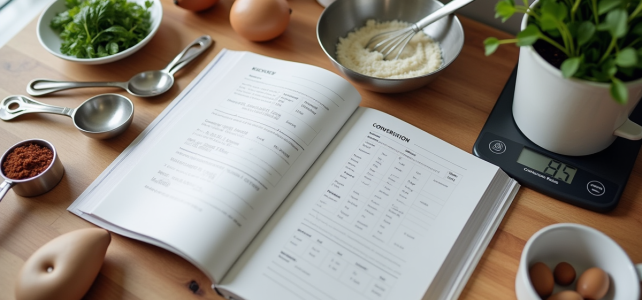
When preparing a dish, precision is often the key to success in the kitchen. Knowing how to convert measurements is essential, especially when juggling between American and European recipes. A tablespoon of flour does not weigh the same as a tablespoon of sugar, and converting between grams and ounces can quickly become a headache.
A good cook must master these subtleties to ensure consistent results. Whether for delicate pastries or more elaborate dishes, every gram counts. Knowing the equivalences between different units of measurement becomes a valuable asset for any cooking enthusiast.
See also : Cooking and Measurements: Essential Conversions to Memorize
Essential Units of Measurement in Cooking
Cooking requires a sharp understanding of different units of measurement. In France, the metric system is used, but international recipes may require precise conversions.
Volume Units
- Centiliters (cl): 1 cl equals 0.01 liters or 10 milliliters.
- Deciliters (dl): 1 dl corresponds to 10 cl.
- Liters (l): 1 liter is equal to 100 cl.
- Milliliters (ml): 1 ml represents 0.1 cl.
Weight Units
- Grams (g): 1 g is equal to 0.001 kilograms.
- Kilograms (kg): 1 kg equals 1000 g.
Specific Conversions for Certain Ingredients
Ingredients do not all have the same density. Converting 20 cl of cream into grams, for example, can be problematic, as the density of cream is not the same as that of water. For precise conversions, here are some useful values:
Further reading : Organizing Your Trip to Mauritius: Essential Information for a Successful Stay
- Water: 1 dl equals 100 g.
- Flour: 1 dl corresponds to 50 g.
- Butter: 1 dl represents 90 g.
- Sugar: 1 dl equals 85 g.
Techniques and Tips for Accurate Conversions
Precision in cooking is often determined by the ability to correctly convert units of measurement. Professionals and passionate amateurs alike use various tools to ensure this accuracy.
Digital Scale: this tool is essential for measuring solid and liquid ingredients with great precision, especially for recipes requiring conversions between grams and milliliters.
Conversion Charts: these resources simplify conversion calculations. A well-structured chart can transform the complexity of imperial units into understandable metric measurements.
Measuring Utensils: graduated measuring cups and spoons facilitate the exact dosing of ingredients. Tablespoons and teaspoons are commonly used for small quantities.
For liquids, use a measuring cup with graduations in milliliters, centiliters, and deciliters. This will allow you to pour the exact required amount without approximation.
For specific ingredients like flour or butter, consider the density. Use reliable resources to understand how to convert volumes into weights. For example, 1 dl of flour equals 50 g, while 1 dl of butter represents 90 g.
These tools and techniques, used together, will ensure accurate measurements and successful recipes.