One moment of inattention, and there goes an entire dessert tipping into the dark side of savory. The art of cooking is also about juggling numbers, translating grams into spoons, and jumping from one system to another without getting lost along the way. Between metric measurements, Anglo-Saxon cups, and American ounces, cooking sometimes resembles a puzzle where every mistake comes at a cost: a dough that doesn’t rise, a sauce that’s too runny, a cake that collapses.
Some have etched conversion tables into their memory, just as others memorize the lyrics of their favorite song. For them, transforming milliliters into spoons happens without hesitation, right in the middle of a preparation rush. This reflex is their safety net. Because here, the slightest deviation, the smallest approximation, can throw everything off balance – or sometimes, offer an unexpected surprise.
Why are conversions in cooking so important for successfully executing your recipes?
Every precise measurement acts like the backbone of a recipe. Deviate just a bit, and the entire balance of a dish wavers: the dough becomes sticky, the cream curdles, the sauce thickens or separates. Not all units play in the same league: the metric system relies on liters, grams, and milliliters, while other cuisines swear by ounces, pounds, or those famous cups so common across the Atlantic. Navigating between these worlds requires vigilance, habit… and sometimes, a good dose of cleverness.
Try making a Margherita pizza without strictly adhering to the amounts of water, flour, salt, or yeast: the result never lies. That’s why keeping a conversion table handy or pulling out your mobile app can save a dinner. The measuring cup and the scale then become indispensable allies, especially when decoding a recipe in a foreign language or quickly converting an exotic unit.
To gain speed and confidence, it’s best to have a few essential equivalents in mind:
- 1 tablespoon = 15 ml
- 1 teaspoon = 5 ml
- 1 cup = 240 ml
- 1 liter = 100 centiliters (cl)
- 1/4 liter in cl: a conversion that is often encountered and deserves your full attention, as explained on the dedicated page ‘1/4 liter in cl: conversion for everyday cooking – La Table de Jeanne’
Mastering equivalents and measurements in cooking helps avoid many missteps. Each ingredient – whether it’s flour, egg, oil, or milk – requires adjusting according to its density, absorption capacity, or reaction to cooking. Here, approximation has no place. In the grand culinary theater, every unit makes a difference, every conversion can turn the ordinary into a masterpiece… or into a memorable failure.
Practical tables and foolproof tips for measuring without mistakes
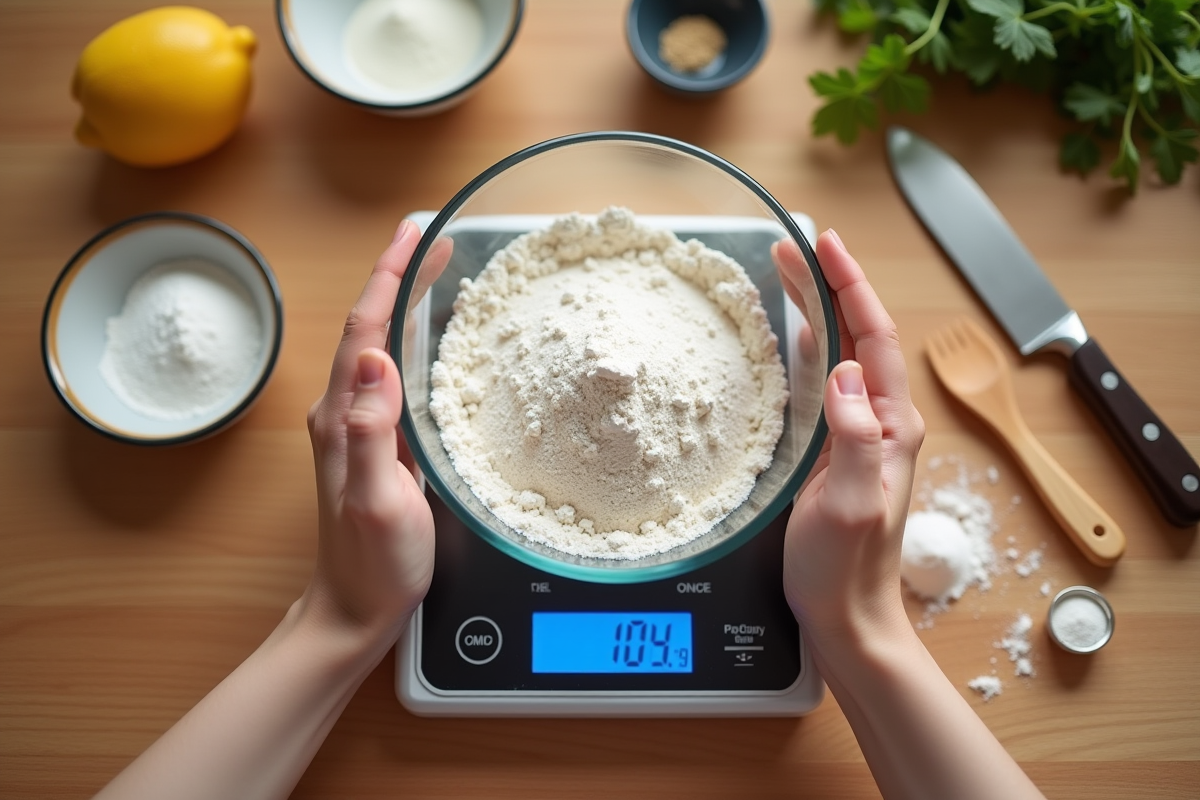
The ability to juggle equivalents makes all the difference between approximate cooking and precise preparation. Solid or liquid, each ingredient imposes its own conversion rules. The measuring cup and the scale remain the best allies to limit discrepancies. But, in the heat of the moment, nothing beats a concise table stuck on the fridge or tucked away in a drawer.
| Unit | Equivalent |
|---|---|
| 1 tablespoon | 15 ml |
| 1 teaspoon | 5 ml |
| 1 cup | 240 ml (liquid) / 120 g (flour) |
| 1 cl | 10 ml |
| 1 dl | 100 ml |
| 1 liter | 100 cl = 1000 ml |
| 1 kg | 1000 g |
| 1 ounce (oz) | 28 g |
| 1 pound (lb) | 454 g |
- Flour: sift and level before measuring. Remember: 1 tablespoon = 12 g, 1 teaspoon = 4 g.
- Butter: cut cleanly, don’t guess randomly: 1 tablespoon = 12 g.
- Liquids: adjust according to density. 5 cl of water = 50 g, 5 cl of milk = 51.5 g, 5 cl of olive oil = 46 g.
Even the oven thermostat requires knowing how to decipher: thermostat 6 corresponds to 180°C, or 350°F. This rigor, this attention to detail, is what separates a flat tart from an airy soufflé, dense bread from a fluffy cloud. Cooking does not forgive approximation, but it rewards mastery. So, the next time you measure, think about it: every conversion is a step closer to the perfect recipe. Who knows, maybe the best surprise will come from the right calculation…