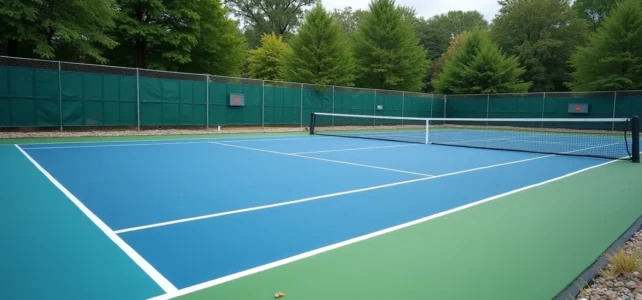
The construction of a tennis court is not just about pouring a slab and putting up a net. The choice of the foundation complex, the hydraulic management of the ground, and the type of surface determine the durability, operating costs, and playing comfort for the decades to come.
Soil Bearing Capacity and Foundation Complex Design
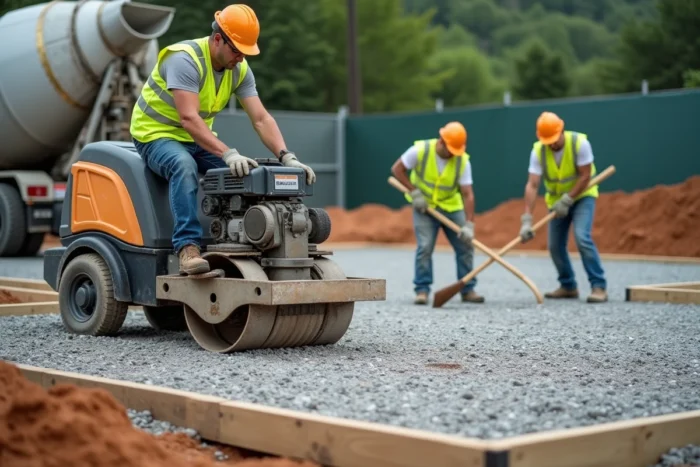
A tennis court rests on a multi-layer structural system whose design directly depends on the geotechnical study. Without this prior diagnosis, any decision regarding the thickness of the foundation or the choice of binder is risky.
Related reading : Tips and Key Steps for Successfully Installing Plasterboard Partitions at Home
On swelling clay soil, we recommend a layer of untreated gravel (GNT 0/31.5) at least deep enough to go below the shrink-swell zone, complemented by a contaminant-resistant geotextile. On draining sandy ground, the thickness can be reduced, but the Proctor density must be checked at each layer.
The often underestimated technical point concerns the flatness of the leveling layer. A tolerance greater than a few millimeters under a three-meter rule generates residual puddles that degrade the surface coating and cause irregular bounces.
You may also like : Discover a gourmet selection of pastries and artisanal sweets to savor
To delve into the regulatory steps and the choice of surfaces, the construction of a tennis court details the administrative procedures to be carried out alongside the construction site.
Rainwater Management and Regulatory Permeability
Since 2023, French regulations on rainwater management have tightened for any new surface waterproofing. A court made of asphalt or concrete must now include a retention or infiltration system, or risk having the development permit denied.
Two opposing strategies exist:
- The draining porous concrete, which allows water to percolate directly through the slab to a bed of calibrated gravel serving as a buffer basin. This solution eliminates the need for a swale or external tank, but it requires regular maintenance (high-pressure vacuuming) to prevent clogging of the pores.
- The classic impermeable court (asphalt, acrylic resin) combined with a network of peripheral drains connected to a retention basin sized according to local rainfall. The overall cost increases, but the surface remains easier to renovate.
- Synthetic clay on a permeable slab, a compromise that is gaining traction in clubs looking to reduce watering while complying with infiltration regulations.
In Île-de-France, the specifications of the Pact for Sustainable Construction (deliberation CR 2023-015) require a simplified carbon footprint study of materials (concrete, asphalt, acrylic resins) to obtain certain regional subsidies. We observe that this requirement is gradually spreading to other communities.
Tennis Court Surface: Balancing Playability and Maintenance Costs
The surface is the item that weighs most heavily on the long-term operating budget, more so than the initial investment. A 2023 Tennis Europe survey confirms the net increase in synthetic surfaces and porous concrete at the expense of traditional clay, primarily to reduce watering and labor costs.
Natural clay offers superior joint comfort and a slower game appreciated in competition. In return, it requires daily brushing, regular watering, and seasonal restoration (adding crushed brick, repainting lines). For a club with dedicated staff, the maintenance cost remains manageable. For a private court, it is rarely viable.
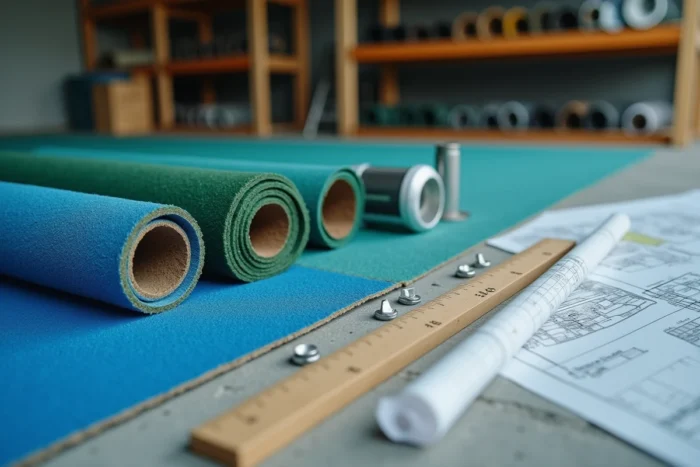
Acrylic resins (type “hard court”) present a good compromise: playable surface all year round without watering, limited maintenance to an annual high-pressure cleaning and repainting every five to eight years. The speed of play depends on the grain size of the sand incorporated into the finishing layer.
Sand-filled synthetic grass, long confined to padel, is also finding its place on municipal tennis courts for recreational use. Its lifespan heavily depends on the quality of the fiber (monofilament polyethylene versus fibrillated) and the silica sand filling rate.
Administrative Procedures for Building a Tennis Court
A tennis court measures several hundred square meters once the regulatory clearances are included. In France, any ground area exceeding the threshold set by the urban planning code requires at least a prior declaration of work. Beyond a certain threshold or in the case of high fences, a development permit becomes mandatory.
Before submitting the application, we recommend checking three points:
- The Local Urban Plan (PLU) of the municipality, which may prohibit waterproofing in certain areas or impose a biotope coefficient.
- Any potential easements (network passage, flood zone, proximity to a historical monument) that extend the processing times.
- Neighborhood rules: distances to property lines, height of fences and lighting, noise nuisances related to the impact of the ball on certain surfaces.
The absence of consultation of the PLU before launching the project remains the primary cause of administrative blockage that we encounter on this type of construction site.
Orientation, Lighting, and Peripheral Equipment of the Court
The north-south axis of the court limits solar glare in the late afternoon, the period of maximum attendance. A deviation of more than fifteen degrees from this axis significantly degrades visual comfort during service.
For lighting, LED projectors with asymmetric beams have replaced metal halides in almost all new installations. Their reduced consumption and longer lifespan justify the initial extra cost. A uniform illumination of at least 300 lux on the ground is the standard for competitive club use.
The peripheral equipment (net, posts, windbreak tarp, fences) are not secondary accessories. A poorly anchored post or an undersized fence against the wind generates costly repairs in the early years. Securing the posts in concrete sleeves integrated from the foundation phase avoids drilling the slab afterward.
The success of a court depends as much on the rigor of the earthworks as on the choice of surface and adherence to local regulatory constraints. Every technical decision, from soil bearing capacity to rainwater management, impacts the operating costs throughout the installation’s lifespan.