
A shelf to fix, a piece of furniture to assemble, a bathroom seal to redo: DIY at home often starts with a specific need. The classic reflex is to buy an all-in-one kit sold in supermarkets. The problem is that these kits contain tools of varying quality, half of which will never be used.
It’s better to build your toolkit piece by piece, choosing each tool for actual use. The result: less unnecessary spending, more comfort, and cleanly completed work.
Adapting your toolbox for DIY in an apartment
Have you noticed that some tools take up more space than they are useful for in a small area? In an apartment, storage space is limited, noise disturbs the neighbors, and the work is rarely heavy. The toolbox should reflect these constraints.
A multi-bit screwdriver replaces a dozen individual screwdrivers. A compact battery-powered drill-driver covers almost all needs (fastening, light drilling in drywall or brick). A small hand saw is sufficient for cutting down a curtain rod or a wooden batten.
The idea is not to own the maximum number of tools, but to choose versatile tools suited to your space. A five-meter tape measure, a compact bubble level, and a quality cutter complete the bare essentials for most home projects. Before finalizing your selection, browsing the equipment offered by Cécile Bricole allows you to quickly identify what’s missing from your toolbox.
Store everything in a rigid toolbox rather than a soft bag. The toolbox protects the blades, prevents bits from getting lost, and easily slides under a bed or into a closet.
Cordless or corded drill: the choice that determines everything else
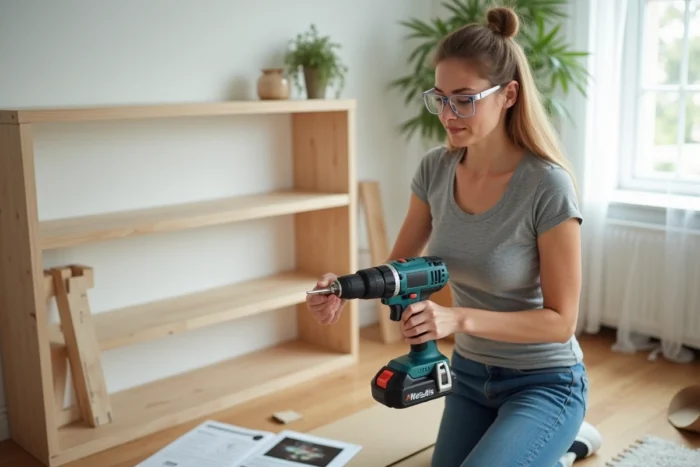
The drill is the most used power tool in home DIY. Yet, many DIYers hesitate for a long time between a corded model and a battery-powered model. The determining factor is neither the price nor the brand, but the type of materials you drill most often.
When the cordless drill is sufficient
For screwing, unscrewing, drilling wood, drywall, or hollow brick, a cordless drill-driver of 18 V covers the majority of situations. In recent years, manufacturers like Bosch and DeWalt have developed modular ranges: the same battery can be used for the drill, jigsaw, and then the workshop vacuum.
This interchangeable battery system changes the game. You invest once in two batteries and a charger, then you can add tools as needed without buying additional power sources.
When the corded option remains relevant
For drilling solid concrete or hard stone, a corded hammer drill delivers a constant power that the battery cannot maintain for long. If you plan to install anchors in a load-bearing concrete wall, the corded hammer drill remains more reliable for this type of material.
A reasonable compromise is to own a cordless drill-driver for everyday use and to rent a hammer drill for occasional concrete work. Renting costs a few euros per day and avoids a purchase that will sit unused in a closet.
Measuring and safety tools: what DIYers overlook the most
A hole drilled in the wrong place, a shelf that leans, a crooked cut: most DIY failures come from approximate measurements or insecure actions. Measuring and protective tools are the first to be sacrificed in a budget, even though they determine the precision of the result.
Measure before cutting
A reliable tape measure and a carpenter’s pencil form the basic duo. For alignment work (hanging frames, shelves, tall furniture), a compact laser level allows you to mark horizontal and vertical lines in seconds.
Why choose this over a traditional bubble level? Because the laser frees up both hands. You set the device, it projects the line, and you can mark your points alone, without having to hold a tool against the wall. A laser level reduces placement errors when working alone.
Protecting your eyes and hands
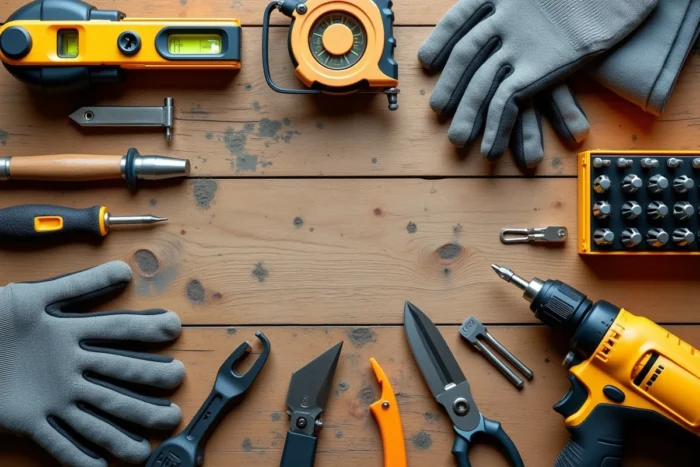
Safety glasses and work gloves are not just for professional sites. A chip of plaster in the eye or a cut from a metal burr can happen quickly. Here are the minimum protections to keep in your toolbox:
- Wrap-around safety glasses, worn whenever drilling, sawing, or sanding a hard material.
- Handling gloves with reinforced palms, useful for handling raw wood, metal, or abrasive materials.
- Reusable earplugs, to be used whenever working with a power saw or hammer drill for more than a few minutes.
Saw, pliers, and additional tools to go further
Once the drill and measuring tools are in place, a few targeted additions open the door to more varied projects without turning your home into a professional workshop.
A jigsaw allows you to cut wood, laminate, and some thin metals simply by changing the blade. If you choose a model compatible with your drill’s battery system, you avoid buying an additional charger.
A slip-joint pliers and a cutting pliers cover light plumbing tasks and small electrical work (after turning off the power). Add a set of Allen wrenches, often necessary for assembling flat-pack furniture, and a roll of electrical tape.
The classic mistake is to buy a pre-filled toolbox with thirty pieces to “be safe.” In practice, five or six well-chosen tools solve the vast majority of home tasks. Specialized tools (router, orbital sander, circular saw) are only justified when a specific project requires them.
The best investment in DIY is not the latest trendy tool, but one that matches your actual projects, stored in an accessible place, and that you know how to use safely.